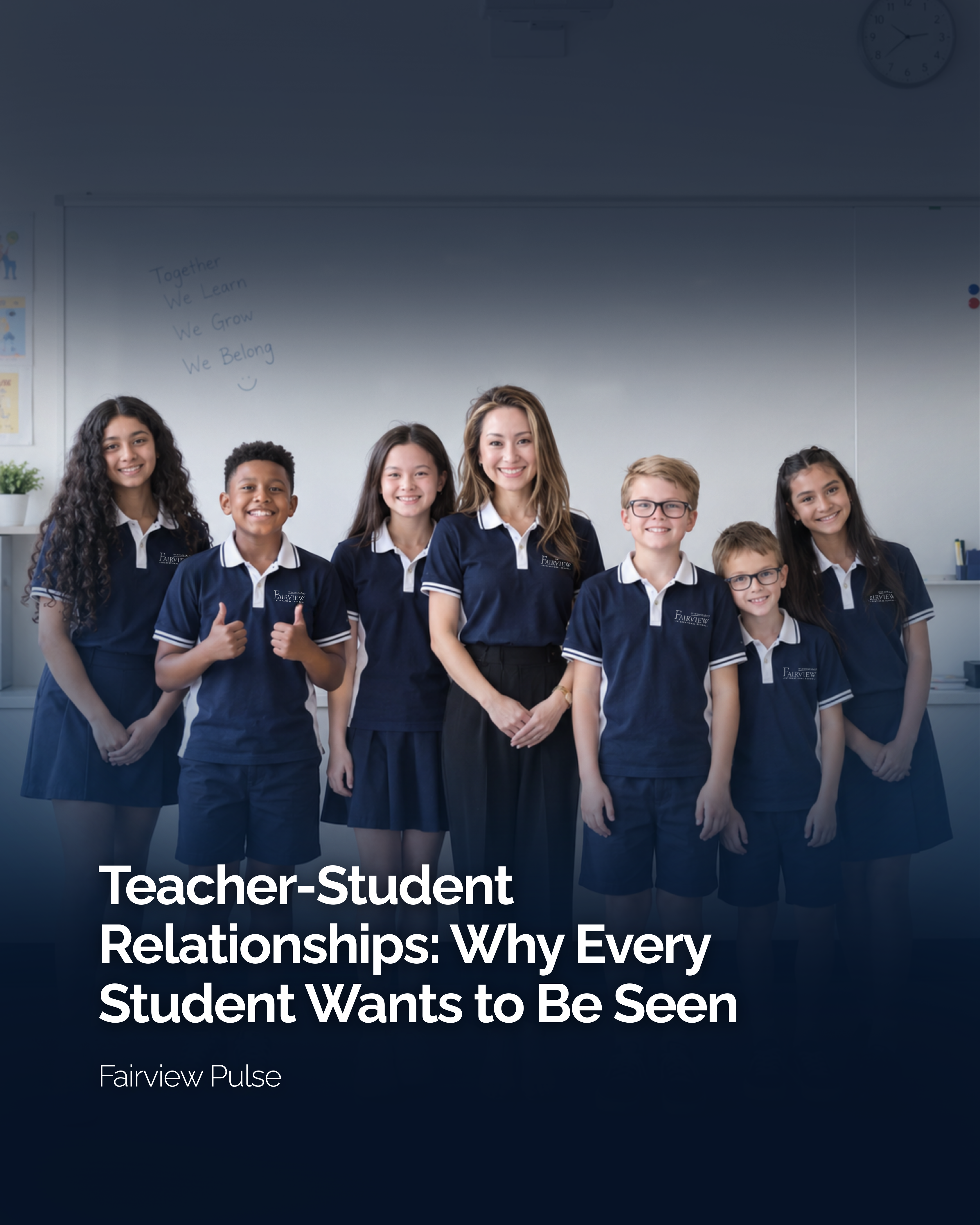
Strong teacher-student relationships can change how students experience school. In a bustling city in Vietnam, Mrs. Wong, the newly appointed principal of an international school, stood at the entrance to her office with a clear vision for the year ahead.
She had the teaching strategies. She had the ideas. She had plans for new approaches that could transform the learning experience for her students.
Yet something did not feel right.
The students were not responding in the way she had expected. Some seemed disengaged, while others kept to themselves. Despite everything the school was doing, there was a sense that some students were simply passing through the day without feeling truly connected to it.
Mrs. Wong eventually realised that the answer was not another teaching strategy.
It was something much simpler.
She needed to know her students.
When Students Feel Invisible
Education can easily become focused on what students need to learn.
Are they completing their work? Are they meeting learning outcomes? Are their grades improving? Are they prepared for the next stage?
These questions matter. But there is another question worth asking:
Do our students feel that someone at school knows them?
A student is not simply a learner sitting in a classroom. They have interests, worries, friendships, ambitions, frustrations and experiences that shape how they learn.
When schools overlook these things, learning can start to feel like a transaction rather than a relationship.
This is why teacher-student relationships matter. Research from the OECD has found that positive relationships between students and teachers are linked to academic performance, happiness and a sense of belonging at school.
And this remains a very current issue.
A September 2026 report from Education Week found that only 48% of surveyed middle and high school students said they look forward to going to school every day or most days. The report also highlighted the importance of trusted adults, regular check-ins and a sense of belonging.
The question for schools is not simply whether students are learning.
It is whether they feel connected enough to want to learn.
Being Seen Is More Than Being Noticed
Mrs. Wong decided to change how her school approached its students.
Her first step was to understand them better.
She invited students to complete simple personality and interest surveys. The purpose was not to put students into boxes or give them permanent labels. Instead, the surveys helped teachers notice interests and preferences that might otherwise go unnoticed.
But the surveys were only the beginning.
Teachers began having more conversations with students. They paid attention to what excited them, what made them withdraw and which activities gave them confidence.
As these conversations continued, some previously quiet students began to participate more. Other students who appeared confident on the surface had more opportunities to talk about what they found difficult.
The school was beginning to understand an important distinction:
Seeing a student is not the same as simply noticing that they are there.
To truly see them means paying attention to who they are.
Why Teacher-Student Relationships Matter
This idea has become particularly relevant as schools continue to look at student engagement and belonging.
Recent reporting on student engagement has highlighted the importance of adults who recognise students’ talents and interests, check in on how they are doing and help them think about their future.
That changes how we think about engagement.
Engagement is not simply about getting students to raise their hands or complete their assignments. It can begin with something much more human.
A teacher remembers what a student is interested in.
They notice when a normally talkative student becomes unusually quiet.
They give a student another opportunity after they get something wrong.
Most importantly, the student knows there is an adult in school they can approach.
These moments may seem small, but they shape how students experience school.
Strong teacher-student relationships can give students a greater sense of connection and belonging. They also give teachers a better understanding of the individuals sitting in front of them.
Three Ways Schools Can Build Strong Teacher-Student Relationships
1. Know More Than Their Grades
Grades tell us something about a student, but they do not tell us everything.
Teachers can use simple interest surveys, conversations and classroom observations to understand what students enjoy, what motivates them and where they feel most confident.
The goal is not to create a profile for every child.
It is to build enough understanding to make interactions more personal.
Ask students what they enjoy. Find out what they are curious about. Remember what they told you last week.
Sometimes, being remembered is part of being seen.
2. Make Sure Every Student Has Someone
One of Mrs. Wong’s most practical changes was to look at the relationships within the school.
Did every student have an adult they could comfortably approach?
Did teachers know which students might need more connection?
Were there students who were quietly slipping through the gaps?
Schools can make these questions part of their student support work.
A simple connection map can help staff identify students who may not yet have a strong relationship with an adult in school.
The aim is not surveillance.
It is connection.
3. Recognise Effort, Progress and Character
Students do not only need to hear when they have achieved something impressive.
They also need adults to notice the process.
A teacher might say, “I noticed how you kept trying,” or “I saw how you helped your classmate.”
They might point out a thoughtful question or check in with a student who seems quieter than usual.
These are simple statements, but they tell students that someone is paying attention.
When students know that someone is paying attention, school can start to feel like a place where they belong rather than simply a place they attend.
What Happens When Students Feel Seen?
Over time, Mrs. Wong noticed changes across the school.
Students who had previously stayed on the edges of classroom discussions began contributing more. Teachers also developed a better understanding of the students in front of them.
Students became more comfortable asking questions and talking about difficulties. The school community grew more connected because teachers and students were making stronger relationships.
There was also a change in the teachers themselves.
They were not simply delivering lessons. They were getting to know the people they were teaching.
That distinction matters.
A strong learning environment is built not only through curriculum, resources or technology. It also grows through the everyday relationships that help students feel safe enough to participate, ask questions, make mistakes and keep going.
Education Starts With the Person in Front of You
This is one of the reasons student-centred learning matters.
At Fairview International School, we believe education should prepare children for life, not just exams. That means looking beyond whether a student can reproduce an answer and paying attention to how they think, communicate, collaborate and grow.
We Prepare Children for Life, Not Exams.
That requires teachers to see students as individuals, not numbers on a spreadsheet.
It means creating opportunities for students to discover what they are good at, ask questions, take ownership of their learning and develop confidence in their own voice.
Fairview’s IB programmes support this broader approach to learning. The PYP focuses on the whole child, while the MYP develops communication, collaboration, self-expression and connections to the real world.
It also means recognising that every student will not engage in exactly the same way.
Some students will speak first, while others will need more time. Some will lead from the front, while others will make their biggest contribution quietly.
The job of a good school is not to make every student look the same.
It is to create enough space for each student to be known.
Everyone Wants to Be Seen
Mrs. Wong started with sophisticated teaching strategies because she wanted to improve learning.
What changed her school was something much more basic.
She started paying attention to the people she was trying to teach.
That may be one of the simplest lessons in education.
Before we ask students to perform, participate and achieve, we should ask whether they feel that they belong.
Before we ask them to find their voice, we should make sure someone is listening.
And before we assume a quiet student has nothing to say, perhaps we should ask whether anyone has taken the time to listen.
Everyone wants to be seen.
Students are no different.
Sometimes, the most meaningful thing a teacher can say is not another instruction.
It is simply:
“I see you.”