You Don’t Need to Struggle Alone
James was a business-savvy professional with an impressive track record.
Then he became the director of a new international school in Indonesia.
Suddenly, his world looked very different.
He had to manage teacher timetables, curriculum planning, staffing, parent expectations, budgets, HR and operations. Even deciding what should go on the canteen menu became part of his day.
James was used to running things.
But running a school was different.
The more he tried to handle everything himself, the more obvious one uncomfortable truth became:
You can be a capable leader and still struggle when you are expected to figure everything out alone.
The International School Sector Is Getting Bigger. So Is the Complexity.
The international school sector has changed dramatically.
According to ISC Research’s 2026 Global International Schools Snapshot, there are now more than 15,000 international schools educating around 7.7 million students worldwide. The market is increasingly driven by local family demand, while school groups are also scaling and becoming more systemised.
That growth creates opportunity.
It also creates new challenges.
A school that starts with a passionate founder and a small leadership team can look very different once it has hundreds or thousands of students, a larger workforce and more complex operations.
The question is no longer simply, “Can you run a school?”
It becomes, “Can you build a system that allows the school to run well without everything depending on you?”
That is a very different leadership challenge.
The Problem With Doing Everything Yourself
For many school leaders, the instinct is understandable.
If something needs fixing, they fix it. If a teacher needs support, they step in. If the timetable is broken, they solve it. When the budget needs reviewing or HR has an issue, they deal with that too.
If parents have concerns, they become the person who responds.
Before long, the school leader becomes the person everyone calls.
That can feel like leadership. Sometimes, however, it is simply overload.
A principal or school director should understand what is happening across the organisation. But understanding everything does not mean personally doing everything.
This distinction becomes increasingly important as schools grow. The more complex an organisation becomes, the harder it is for every decision to depend on one person.
This Is Becoming a Bigger Conversation
This is not just a Fairview perspective.
The international school sector is increasingly talking about scale, sustainability and systemisation. Recent ISC Research analysis points to a market where school groups are growing and operating models are becoming more structured.
The industry is maturing.
As it does, schools need more than passionate individuals. They also need systems, shared expertise and processes that allow people to work together effectively.
That is where an international school network can make a difference.
You Don’t Have to Reinvent the Wheel
Imagine James had access to an international school network.
Instead of asking, “How do I solve this?”, he could ask, “Has anyone else already solved this?”
That small change can make a big difference.
A network gives school leaders access to people who have already faced similar challenges. Someone may have dealt with the staffing issue, while another leader may have found a better way to manage curriculum planning or school operations.
Another may have handled a difficult parent conversation before.
Instead of starting from zero, you can learn from experience that already exists within the network.
That is not about avoiding responsibility.
It is about having the right support around you.
1. Shared Curriculum and Expertise
Curriculum development takes time.
Teachers need time to plan, collaborate, assess and reflect. School leaders also need to make sure that the curriculum remains coherent and aligned with the school’s educational approach.
An international school network can create opportunities to share curriculum resources, teaching strategies and professional expertise across campuses.
This does not mean every school has to become identical.
It simply means teachers do not have to solve every problem from scratch.
When one school finds an approach that works, other schools can learn from it. Good ideas can move across the network instead of staying in one classroom or one campus.
2. Shared Services
There are also many parts of running a school that have little to do with teaching.
Finance, human resources, marketing, operations, procurement, technology and compliance all require time and expertise.
Expecting every school leader to become an expert in all of these areas is neither realistic nor sustainable.
Shared services can provide specialist support while allowing school leaders to spend more time with their students, teachers and wider school community.
This becomes even more relevant as school groups grow and their operating models become more structured.
The principle is simple: schools can often do more when they do not have to do everything separately.
3. Peer Learning
Perhaps the most valuable resource in an international school network is not a policy document.
It is another school leader.
Leadership can be lonely. School leaders are expected to make decisions, support their teams, reassure parents and keep the organisation moving forward.
Sometimes, they simply need someone who understands the situation.
Someone who can say, “We’ve been through this too.”
That kind of peer learning is difficult to put a price on.
It allows schools to share challenges instead of hiding them. It also makes asking for advice feel like good leadership rather than weakness.
Most importantly, a solution developed in one part of the network can become useful learning for everyone else.
The Real Benefit: You Can Focus on What Matters
The purpose of an international school network should not be to make school leaders dependent on a central office.
It should give them more freedom to lead.
When operational processes are supported, leaders can spend more time with their teams. When curriculum resources are shared, teachers can spend more time improving learning.
When specialist expertise is available, school leaders do not have to become experts in every function. And when peers are accessible, difficult decisions do not have to be made in isolation.
The goal is not to remove responsibility.
It is to remove unnecessary isolation.
Fairview: A Network Built Around Shared Learning
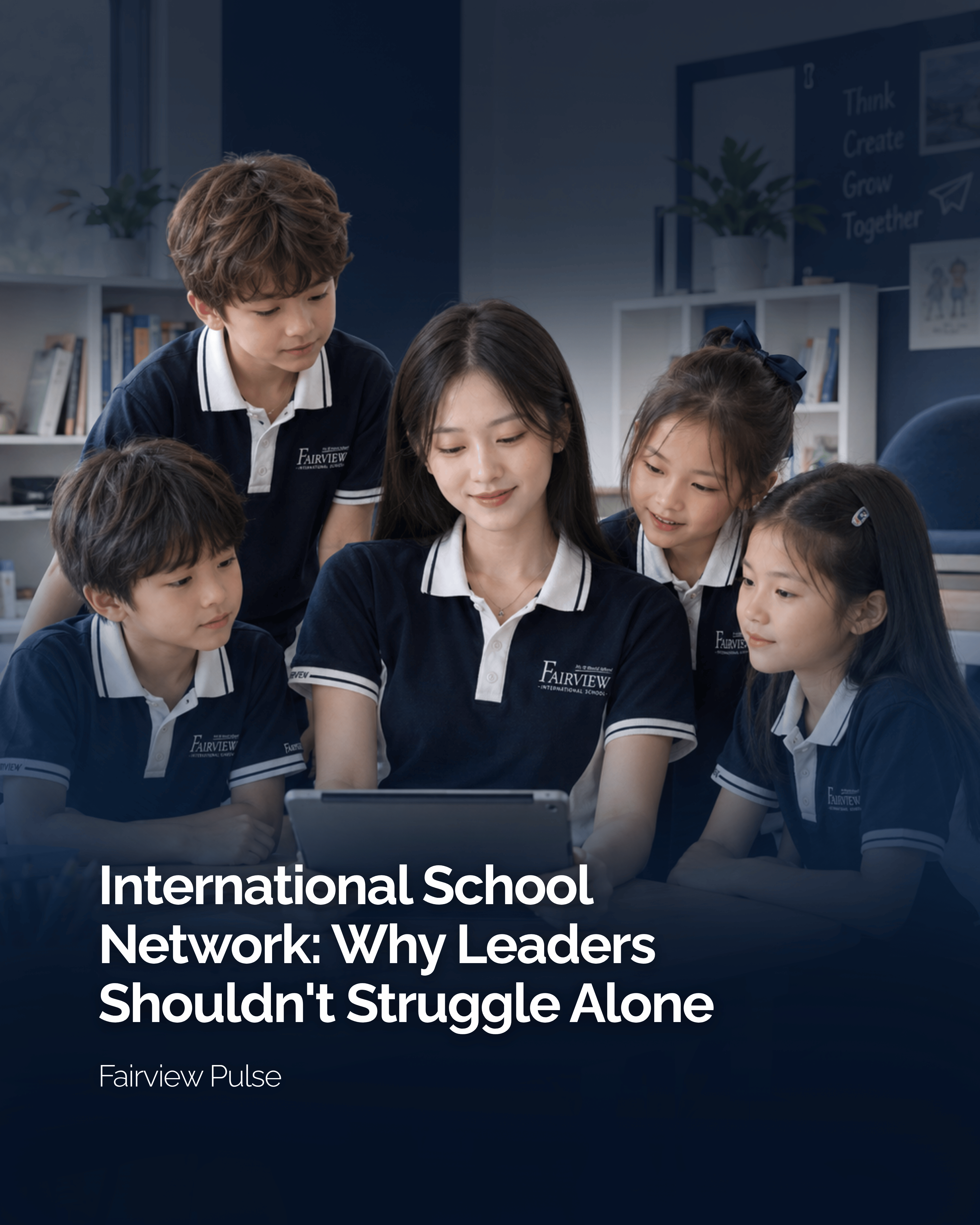
At Fairview International School, being part of a network means more than sharing a name.
Fairview’s network spans campuses across Malaysia, bringing together different school communities, experiences and perspectives.
That creates something valuable.
A school leader does not have to face every challenge for the first time. There is a wider community to learn from, along with colleagues who have experienced different situations.
There are also systems and expertise that can be shared.
Over time, individual experience can become collective knowledge. That is one of the strengths of an international school network.
Growth Should Not Mean Growing Alone
The international school sector is growing. But growth should not mean that every school leader carries a bigger workload on their own.
As schools become larger and more complex, the way they are led needs to evolve too.
The strongest organisations are rarely built around one person who knows everything. They are built around people who understand what they do well, recognise where they need support and know who they can turn to.
James did not need to become an expert in everything.
He needed the right people around him, supported by the right systems and expertise.
Because leadership was never supposed to mean having every answer.
Sometimes, leadership means knowing when to ask for help.
And perhaps that is one of the most important lessons for any school leader today.
You don’t have to carry the whole school on your shoulders to lead it well.
You just need to make sure you are not carrying it alone.
References
ISC Research, Global International Schools Snapshot 2026.
ISC Research, The Curriculum Growth Map Has Changed. Is Your International Strategy Keeping Up?, August 2026.
ISC Research, International Schools Market.