Choosing a school in Malaysia often begins with a familiar question: should your child continue in a government school, or would an international curriculum suit them better?
For parents considering national curriculum vs IB in Malaysia, the answer is rarely about which system sounds more impressive. It is about how your child learns, the language they use, the qualifications they may need later, and what your family can reasonably commit to.
With Malaysia’s 2027 government school year beginning in January, this is a useful time to review those questions. Here is how the national and International Baccalaureate (IB) pathways compare, and why Fairview International School may be worth exploring as part of that decision.
First, Understand the Two Pathways
Malaysia’s national route generally moves through primary school, secondary school and an optional pre-university pathway. The IB offers programmes for different age groups, from early childhood through to a two-year pre-university Diploma Programme.
These are different education structures, not exact year-for-year equivalents.
Chart 1: Malaysia’s education pathways at a glance
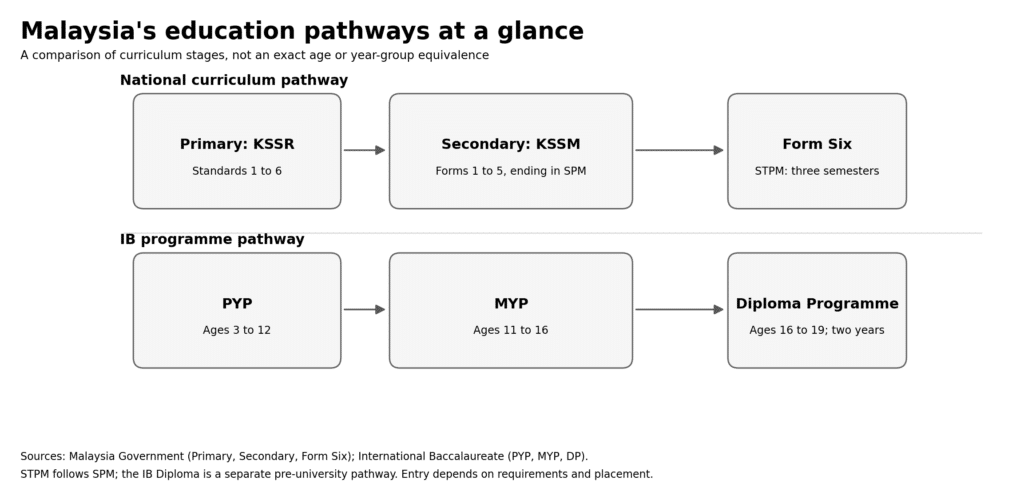
The national route generally progresses from the Primary School Standard Curriculum (KSSR) to the Secondary School Standard Curriculum (KSSM), then potentially to Form Six and STPM. The IB offers the Primary Years Programme (PYP), Middle Years Programme (MYP) and Diploma Programme (DP).
Sources: Malaysia Government: National School, Secondary Education, Form Six and IB Programmes.
Primary School: KSSR Compared with the IB Primary Years Programme
In Malaysia, government primary education runs from Standard 1 to Standard 6. Sekolah Kebangsaan (SK) uses Bahasa Melayu as its main language of instruction. National-type Chinese and Tamil schools, commonly called SJKC and SJKT, use Mandarin and Tamil respectively.
These schools follow the Primary School Standard Curriculum (KSSR), which covers languages, Mathematics, Science and other subjects. These details are set out in the Malaysian government’s guide to national schools.
Importantly, national primary education is not based only on final examinations. The Ministry of Education’s school-based assessment guidance includes ongoing classroom assessment and end-of-session assessments. Teachers can use different forms of evidence to understand student progress.
The IB Primary Years Programme (PYP), for children aged 3 to 12, organises learning around inquiry and connected themes.
The IB explains that children explore questions such as how the world works and how communities organise themselves, drawing on more than one subject as they investigate.
For a Malaysian parent, the practical difference may be the way lessons are organised and how children are invited to explain their thinking. Both pathways teach essential knowledge. The PYP places an explicit emphasis on exploring ideas across subjects, reflecting on learning and taking action.
If your child is moving from SK, SJKC or SJKT, ask how their reading, writing and subject knowledge will be assessed.
Language is another important consideration. The IB’s school directory lists English as the language of instruction at Fairview Kuala Lumpur; parents should also ask how the school supports their child’s Bahasa Melayu and other home languages.
Secondary School: KSSM and SPM Compared with the Middle Years Programme
Malaysia’s national secondary pathway follows the Secondary School Standard Curriculum (KSSM).
Lower secondary covers Forms 1 to 3, with the Ujian Akhir Sesi Akademik (UASA) among the main assessments. Forms 4 and 5 lead towards the Sijil Pelajaran Malaysia (SPM).
The Malaysian government’s secondary education guide sets out this structure.
Alongside examinations, KPM’s school-based assessment system also includes classroom assessment.
It would therefore be misleading to describe every national school lesson as memorisation or every IB lesson as project work. The teaching experience depends on the school and the classroom.
The IB Middle Years Programme (MYP), generally for ages 11 to 16, covers eight subject groups. These include languages, Mathematics, Sciences, Individuals and Societies, Arts, Design, and Physical and Health Education.
The IB MYP curriculum also includes interdisciplinary learning, where students make connections between subjects, and a longer-term personal project.
External MYP eAssessment is an optional element in the final year, not the same examination structure as SPM.
This makes the MYP worth examining if your child enjoys asking questions, developing projects or learning through different subject connections.
However, a change close to SPM requires particular care. Parents should ask how a transfer would affect examination plans, subject coverage and later entry requirements before deciding.
Pre-University: What Is the Difference Between STPM and the IB Diploma?
This is where the two routes need especially careful comparison.
Form Six follows SPM and leads to the Sijil Tinggi Persekolahan Malaysia (STPM).
According to the Malaysian government and the Malaysian Examinations Council, it normally lasts three semesters, or around one and a half years.
It uses semester examinations and, for many subjects, coursework or practical components. STPM is a recognised pre-university qualification with domestic and international progression routes.
The IB Diploma Programme (DP) is a two-year programme generally for students aged 16 to 19. It includes study across six subject groups and a compulsory core.
The core consists of:
- Theory of Knowledge (TOK): Students examine how knowledge is formed.
- Extended Essay (EE): An independent research paper of up to 4,000 words.
- Creativity, Activity, Service (CAS): Learning through creative, active and service experiences.
These requirements are explained in the IB Diploma curriculum and DP core guide.
The IB Diploma also uses examinations. As the IB assessment guidance makes clear, most subjects have final written exams alongside other assessment components.
It is not an exam-free route. The difference is the combination of subject breadth, research, reflection and assessment built into the programme.
Malaysia’s Ministry of Education recognises the IB Diploma as a pre-university qualification that may be used for undergraduate admission in Malaysia and overseas.
However, recognition does not remove university-specific subject, grade or admission requirements. The same care is needed when planning an STPM route.
Neither qualification is the automatic choice for every student. The sensible question is which programme fits the child’s strengths, intended university course, learning preferences and family budget.
A Practical Comparison for Malaysian Parents
| Stage | National pathway | IB pathway | What parents should ask |
|---|---|---|---|
| Primary | KSSR, Standards 1 to 6; school-based assessment | PYP, ages 3 to 12; inquiry across subject areas | How will my child adapt to the language and lesson approach? |
| Secondary | KSSM, Forms 1 to 5; UASA in lower secondary and SPM in upper secondary | MYP, ages 11 to 16; eight subject groups, interdisciplinary units and project work | Will a transfer affect SPM plans or subject continuity? |
| Pre-university | STPM through Form Six, usually three semesters | Two-year IB Diploma, six subjects and a compulsory core | Which university courses accept the planned subjects and grades? |
Sources: Malaysia Government, MPM, IB PYP, IB MYP and IB DP.
This table compares structures, not equivalent grade levels or predicted student outcomes.
Where Fairview’s Academic Record Enters the Conversation
Once you understand the curriculum, it is fair to ask how a school has performed.
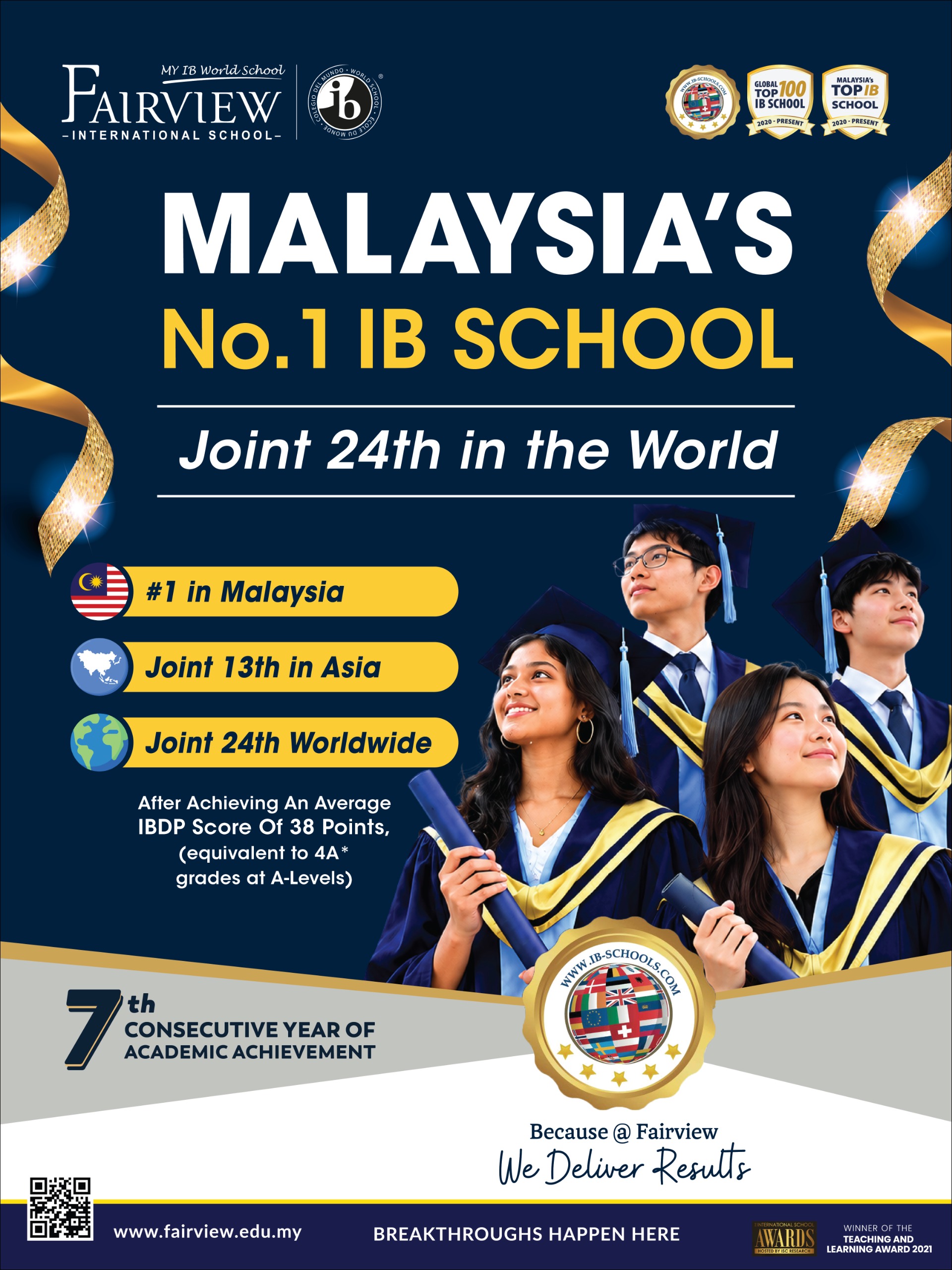
In the provisional 2026 IB-Schools.com Malaysia league table, Fairview International School Kuala Lumpur ranked No. 1 among the Malaysian schools listed, with an average IB Diploma score of 38 points out of 45 across a cohort of 22 students.
For context, the International Baccalaureate reported a global May 2026 Diploma average of 30.88 points, as published in its July 2026 results announcement.
Chart 2: 2026 IB Diploma average scores
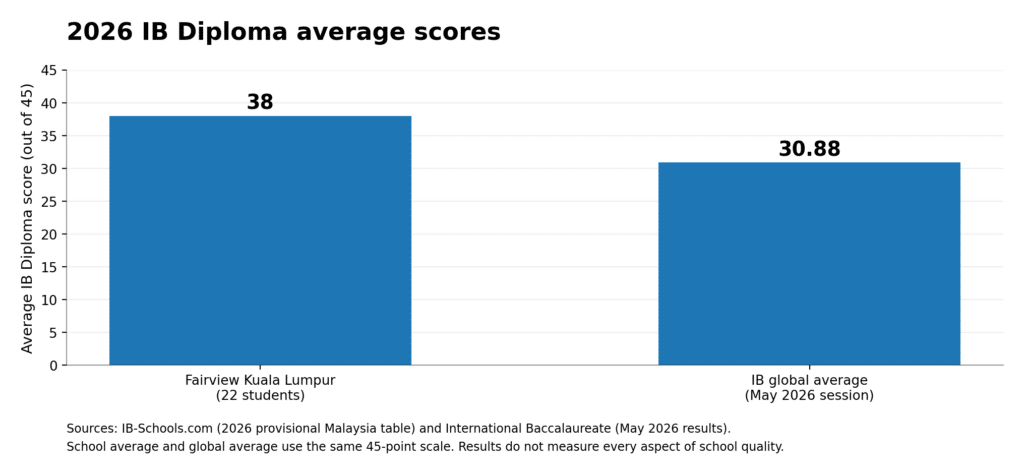
The chart compares Fairview Kuala Lumpur’s average of 38 points with the global IB Diploma average of 30.88 points. Both use the same 45-point scoring scale.
There is also a longer record behind the latest result.
Fairview International PLC’s 30 October 2026 audited results announcement reports that Fairview Kuala Lumpur was among the global Top 100 IB schools for the seventh consecutive year, from 2020 through 2026.
The announcement also reports a 100% IB Diploma pass rate for 2026.
The distinction matters: this is seven consecutive years in the global Top 100, not seven years at No. 1 in Malaysia.
The 2026 Malaysian league-table ranking is provisional, independent and based on participating schools’ Diploma averages. Its publisher also cautions that examination averages cannot describe every aspect of school quality.
For parents, these results are useful evidence, but they should sit alongside questions about teaching, wellbeing, everyday classroom experience and how a child is supported during a move.
Why January 2027 Is a Sensible Time to Review the Decision
The Ministry of Education has confirmed that government schools in both school groups begin their 2027 academic year on 4 January 2027, according to its official calendar notice.
For many families, that makes the period before January a natural time to review progress, talk with their child and compare possible pathways. It can also help avoid waiting until concerns become harder to address.
But January is not automatically the easiest transfer point for every IB student. The school calendar, subject sequence and entry points may not match the national school calendar.
This is particularly important for older students taking examination courses.
A January 2027 enquiry should therefore begin with an academic conversation, not an assumption that the child will enter the same year group or that a place is available.
Fairview’s admissions information describes a placement test and interview as part of its process.
Five Questions to Ask Before Changing Schools
- Will my child feel ready? Ask how the school supports new students socially and academically, and listen to your child’s own concerns.
- How will their learning be matched? Review current reports, language needs, Mathematics and Science progress, and any curriculum gaps.
- What happens to Bahasa Melayu and future qualifications? Discuss subject options and any national qualification requirements that matter to your family’s plans.
- What are the full costs? Request current tuition, registration, transport and other applicable fees, rather than judging affordability from a headline price.
- What comes after school? Check actual university entry requirements before choosing a secondary or pre-university route.
These questions matter whether a child stays in a national school or moves into the IB. A good decision should leave parents more informed and children better supported.
Why Fairview May Be Worth Visiting
Fairview’s educational philosophy puts the focus on preparing children for life, not just examinations.
Its IB programmes give families a route that connects primary learning, secondary development and pre-university study, subject to the programmes available at each campus.
The Kuala Lumpur campus’s academic record gives parents a concrete starting point.
Yet a visit should go further than a ranking. Ask to understand the classroom approach, how teachers explain progress, what support is available for a new student, and which pathway would suit your child.
Fairview’s Malaysian network includes campuses in Kuala Lumpur, Subang Jaya, Penang, Ipoh and Johor Bahru.
Programme availability should be confirmed for the specific campus and year group you are considering.
If your family is thinking about a change, the most useful first step is not to rush an application. It is to understand your options clearly.
Considering a School Change for January 2027?
If your family is considering a different educational pathway, January 2027 offers a useful opportunity to explore your options.
You can learn more about the IB programmes at Fairview, understand how your child would be assessed for placement and discuss whether a change would support their learning.
Enquire about Fairview’s January 2027 intake and speak with the admissions team about the suitable programme, assessment process and availability for your child.
A conversation now can help you decide whether a move is right for your family.
January 2027 entry is subject to campus, programme, year-group placement and confirmed availability. The ranking and cohort figures refer specifically to Fairview Kuala Lumpur.