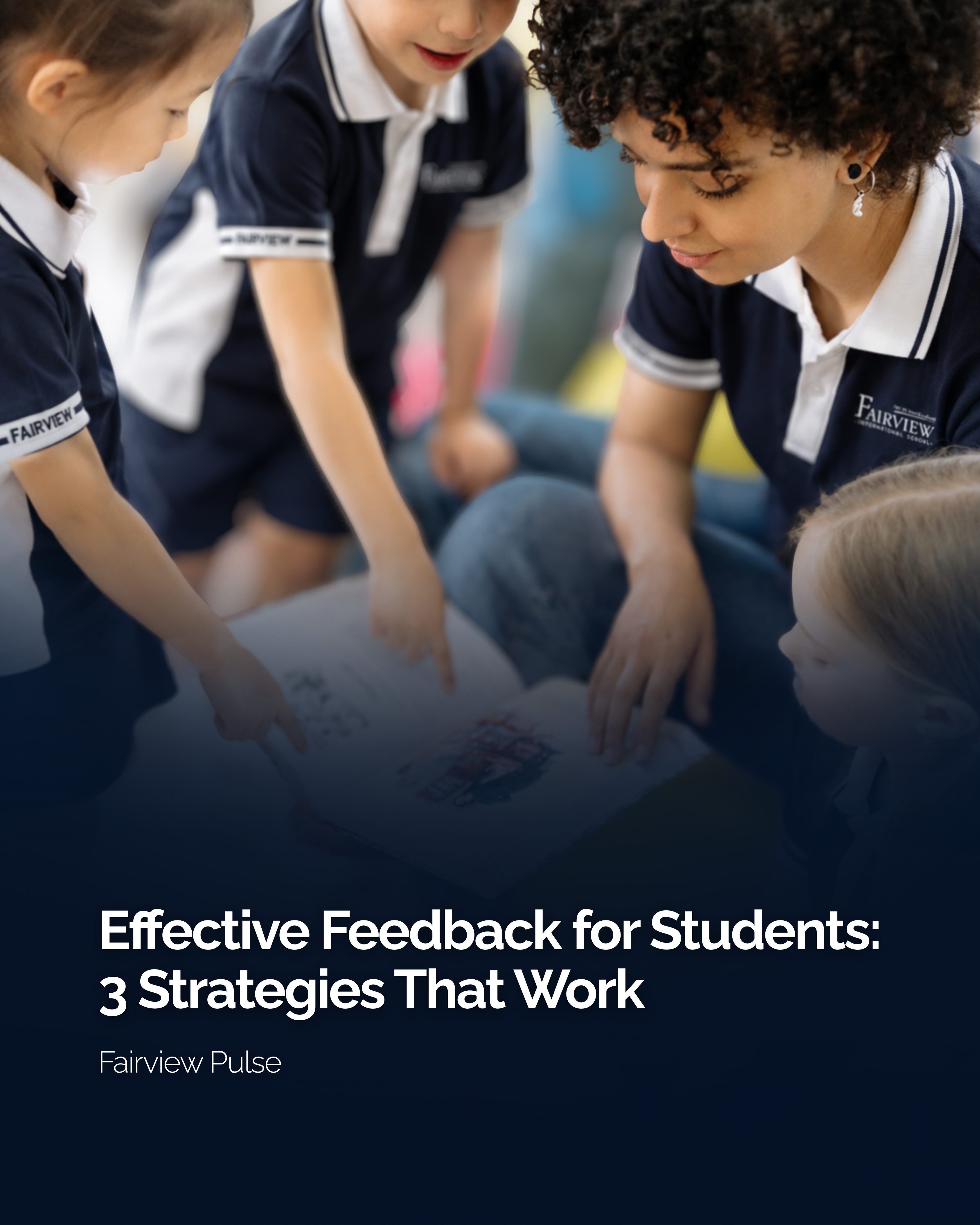
Effective feedback for students does more than tell them whether their work is right or wrong.
Many educators want their students to become independent learners. That means giving students opportunities to think for themselves, solve problems, and learn from their mistakes.
But there is an important question to ask first:
Do students always know how to improve?
Sometimes they do. A learner may have enough knowledge and experience to recognise a mistake and work out what to do next.
At other times, they need guidance.
This is where feedback matters.

Ms. Evan, a new principal at an international school in Malaysia, began to notice that some students were struggling to move forward in their learning. They were receiving grades and occasional comments, but many still did not know what they should do differently.
She realised that telling students whether their work was right or wrong was not enough.
Students needed to be shown how to improve.
The Problem: Feedback Takes Time
Giving useful feedback takes time.
For busy educators, it can be difficult to give every student detailed guidance while also planning lessons, teaching classes, marking work, and supporting students in other ways.
There is also a bigger issue. Not all feedback helps students improve.
A grade can tell a student how well they performed. A comment can point out a mistake. Neither necessarily tells the student what to do next.
The Education Endowment Foundation’s 2026 guidance on developing independent learners highlights the importance of feedback that helps learners understand what success looks like and what they should do next. Just as importantly, students need opportunities to act on that feedback.
For Ms. Evan, this changed the question she was asking.
Instead of asking, “How do I give students more feedback?”, she began asking, “How can I give feedback that actually helps students improve?”
The Solution: Effective Feedback for Students
Students can achieve more when feedback gives them a clear path forward.
Useful feedback helps students answer four simple questions:
- What am I doing well?
- What needs improvement?
- Why does it need improvement?
- What should I do next?
The goal is not to correct every mistake for the student.
Instead, feedback should help learners understand their work and make better choices the next time.
20 Feedback Strategies Teachers Can Use
There is no single way to give feedback. Educators can choose different approaches depending on the subject, task, age group, and needs of their students.
Here are 20 strategies to consider:
- Give immediate feedback when students can still remember their thinking.
- Use clear and specific comments instead of vague statements.
- Give descriptive feedback that explains what the student did and why it matters.
- Highlight strengths and areas for improvement so students know what to keep and what to change.
- Show examples of strong work to make expectations clearer.
- Use checklists and rubrics to give students clear criteria for success.
- Encourage reflection journals so students can think about their own progress.
- Hold regular feedback sessions instead of waiting until the end of a project.
- Use positive reinforcement when students make progress.
- Include peer review so students can learn from one another.
- Teach students how to give feedback so they can become better reviewers.
- Focus on the learning process, not only the final answer.
- Encourage a growth mindset by showing students that improvement takes practice.
- Create regular feedback routines so students know when to expect guidance.
- Use consistent criteria when assessing similar tasks.
- Use student-led conferences to help learners explain their own progress.
- Personalise feedback when students have different needs or learning goals.
- Use digital feedback tools when they make feedback easier to access and understand.
- Give actionable suggestions that students can use in their next attempt.
- Connect feedback to goal-setting so students know what they are working towards.
Teachers do not need to use all 20 at once.
The most useful approach is to choose strategies that fit the learning task and give students a clear next step.
The 3 Most Impactful Feedback Strategies

1. Give Feedback at the Right Time
Feedback is most useful when students can still connect it to the learning task.
That does not always mean feedback must be immediate.
The right timing depends on the task, the learning goal, and what students need to do with the feedback. Sometimes a quick comment during an activity is useful. At other times, students may benefit more from reviewing their work after they have had time to think.
The key is to avoid leaving students unsure about what happened in their work or what they should do next.
How to implement it
During activities
A mathematics teacher might move around the classroom while students solve equations.
Rather than waiting until the end of the lesson, the teacher can spot a common misunderstanding and address it while students are still working.
The student can then correct the approach before the misunderstanding becomes a habit.
Post-activity reviews
A history teacher might review quiz answers with the class soon after the activity.
Instead of simply revealing the correct answers, the teacher can discuss common mistakes and explain the thinking behind the correct response.
Students then have a chance to correct their understanding before moving on.
Digital feedback
Digital tools can also make feedback faster.
A teacher might use a learning platform to leave comments on a student’s work shortly after submission. However, speed should not become the goal by itself.
The feedback still needs to be clear, relevant, and connected to what the student is trying to learn.
A simple example
During a writing exercise, a teacher notices that several students are struggling to structure their paragraphs.
Instead of waiting until the essays are finished, the teacher pauses the activity and models a stronger paragraph structure.
Students can then apply the idea immediately.
That is feedback doing its job.
2. Give Clear and Specific Comments
**“Good job” feels nice.
But it does not tell a student very much.
Specific feedback gives learners something they can act on.
Compare these two comments:
“Good essay.”
and:
“Your argument is clear. Now add evidence to the second paragraph to support your main point.”
The second comment gives the student a direction.
That difference matters.
The Education Endowment Foundation recommends that feedback should be clearly linked to the learning goal and should give learners specific advice about how to move their learning forward.
How to implement it
Focus on the work
Instead of commenting on a student’s ability, focus on what they have done.
For example:
“Your introduction clearly explains the issue. Your next step is to support your second point with evidence.”
The student knows what is working and what to do next.
Break feedback into useful areas
For a science report, a teacher might organise feedback around:
- Understanding of the topic
- Use of evidence
- Organisation
- Explanation
- Accuracy
This makes the feedback easier for students to understand and use.
Use examples
Sometimes the best way to explain a standard is to show it.
An art teacher could show students examples of different approaches and discuss why one is more effective for the task.
A language teacher could compare two pieces of writing and ask students to identify the differences.
Students can then see what the teacher means rather than simply being told.
A simple example
Instead of:
“Your experiment needs improvement.”
A teacher could say:
“Your hypothesis is clear. However, your experiment does not include a control variable. Add one so you can compare your results more accurately.”
The second version gives the learner a clear next step.
3. Use Checklists and Rubrics
Feedback does not always have to come from the teacher.
Students can also learn to check their own work.
Checklists and rubrics make expectations visible before students submit an assignment. They can also help students understand what quality looks like and identify areas they need to improve.
That makes them useful not only for assessment, but also for developing independent learning.
How to implement it
Create clear rubrics
A history teacher might create a rubric covering:
- Clarity of the argument
- Use of evidence
- Development of ideas
- Structure
- Accuracy
Students receive the rubric before beginning the assignment.
This means they know what they are working towards rather than discovering the expectations only after receiving a grade.
Use simple checklists
A checklist can help students review their work before submission.
For an essay, it might ask:
- Have I answered the question?
- Is my main argument clear?
- Have I included evidence?
- Have I explained my evidence?
- Have I checked my work?
The checklist becomes a simple tool for self-assessment.
Involve students in creating the criteria
Teachers can also ask students what they think strong work should include.
This gives students a chance to discuss quality and understand why particular criteria matter.
They are not simply being assessed against a list.
They are learning how to assess their own work.
What About AI Feedback?
Feedback is changing as technology becomes more common in education.
AI tools can now provide comments quickly, identify patterns in student writing, and offer suggestions for revision. Recent research has therefore started comparing AI-generated feedback with teacher feedback.
The findings are not as simple as saying one is always better.
A 2026 study of teacher trainees found that participants valued AI feedback for its speed and structure, but also questioned its reliability, context, and ability to understand individual learners. Teacher feedback was often trusted more because teachers could draw on their knowledge of students and their learning history.
Another recent study involving university students found that both teacher and AI feedback could support improvement, while students viewed the two types of feedback differently.
This gives educators an important principle to consider:
Technology can help deliver feedback. It should not remove the thinking behind feedback.
A tool may identify that a student’s argument is unclear.
A teacher can help the student understand why it is unclear, connect the issue to previous learning, and decide what the student should try next.
That human context matters.
Ms. Evan’s Journey
As Ms. Evan’s school changed its approach to feedback, the benefits were not limited to marks.
Teachers became more deliberate about the comments they gave students.
Students became more familiar with using feedback rather than simply receiving it.
The classroom also began to shift.
Instead of seeing mistakes as proof that they had failed, students had clearer ways to respond to them.
The goal was not to eliminate mistakes.
It was to make mistakes useful.
That is an important difference.
Feedback should help students move from:
“I got this wrong.”
to:
“I know what I need to work on next.”
Feedback Is About Intention
Effective feedback is not simply about giving more comments.
It is about giving the right information, at the right time, in a way that helps the learner take the next step.
That might mean giving feedback during an activity.
It might mean using a clear rubric before an assignment begins.
It might mean asking a student to review their own work.
It might even mean using technology to help provide faster feedback.
Whatever the method, the intention should remain the same:
Help the learner improve.
This matters because feedback can easily become about the adult rather than the student.
A teacher may want to finish marking quickly.
A school may want consistent assessment records.
A digital tool may make it easier to generate comments.
But the most important question remains:
Did the feedback help the learner know what to do next?
How IB Education Supports Effective Feedback
Effective feedback for students also fits naturally with the student-centred approach found across IB education.
In the Primary Years Programme (PYP), students are encouraged to ask questions, explore ideas, and take an active role in their learning.
The Middle Years Programme (MYP) builds on this through inquiry, communication, collaboration, and reflection.
At the Diploma Programme (IBDP) level, students take greater responsibility for their learning and are expected to question ideas, examine evidence, and develop independent thinking.
This approach gives teachers an important role beyond simply delivering content.
They become guides who help students think, question, reflect, and take ownership.
Feedback is an important part of that process because students need to understand not only where they are, but how they can move forward.
Education That Prepares Students for More Than Exams
At Fairview International School, this connects with our belief that education should prepare children for life, not just exams.
Students need to know more than whether an answer is right or wrong.
They need to understand how to improve, how to respond to setbacks, how to assess their own work, and how to keep learning when nobody is standing beside them.
That is why feedback matters beyond the classroom.
The ultimate goal is not to create students who depend on teachers for every answer.
It is to help students become increasingly capable of answering the question for themselves:
“What can I do better next time?”
That is when feedback becomes more than a comment on a piece of work.
It becomes part of learning.