Kishore Mahbubani, the Singaporean diplomat and academic, has spoken of a “hidden genius” in Southeast Asia. In his view, ASEAN countries have learned to manage geopolitics through dialogue, and the region has had no major wars since 1979. For schools, this raises a practical question about peace education: what do students need to practise so that dialogue becomes a habit?
That habit of talking before fighting does not belong only to diplomats. It is also taught, day by day, in classrooms. If we want a world that cooperates rather than competes, we need educators who show those values to students every day.
A region with a record worth studying
Southeast Asia has great ethnic, cultural and religious diversity. ASEAN estimated its population at about 662 million in 2020, and it now has eleven member states.
The Global Peace Index offers one view of how this plays out. In the 2026 edition, Singapore ranks 8th, Malaysia 12th, Timor-Leste 32nd and Vietnam 41st, among 163 countries and territories.
The record is not spotless. Thailand and Cambodia fought along their border in July 2025, and heavy clashes returned in December. After the July fighting, a truce was reached through peace talks held in Malaysia. Myanmar’s conflict also continues, and the UN estimates that nearly 3.8 million people are displaced there.
These cases show that peace takes work. That work is done by people who have learned how to disagree without hurting each other.
Five classroom habits that build peace
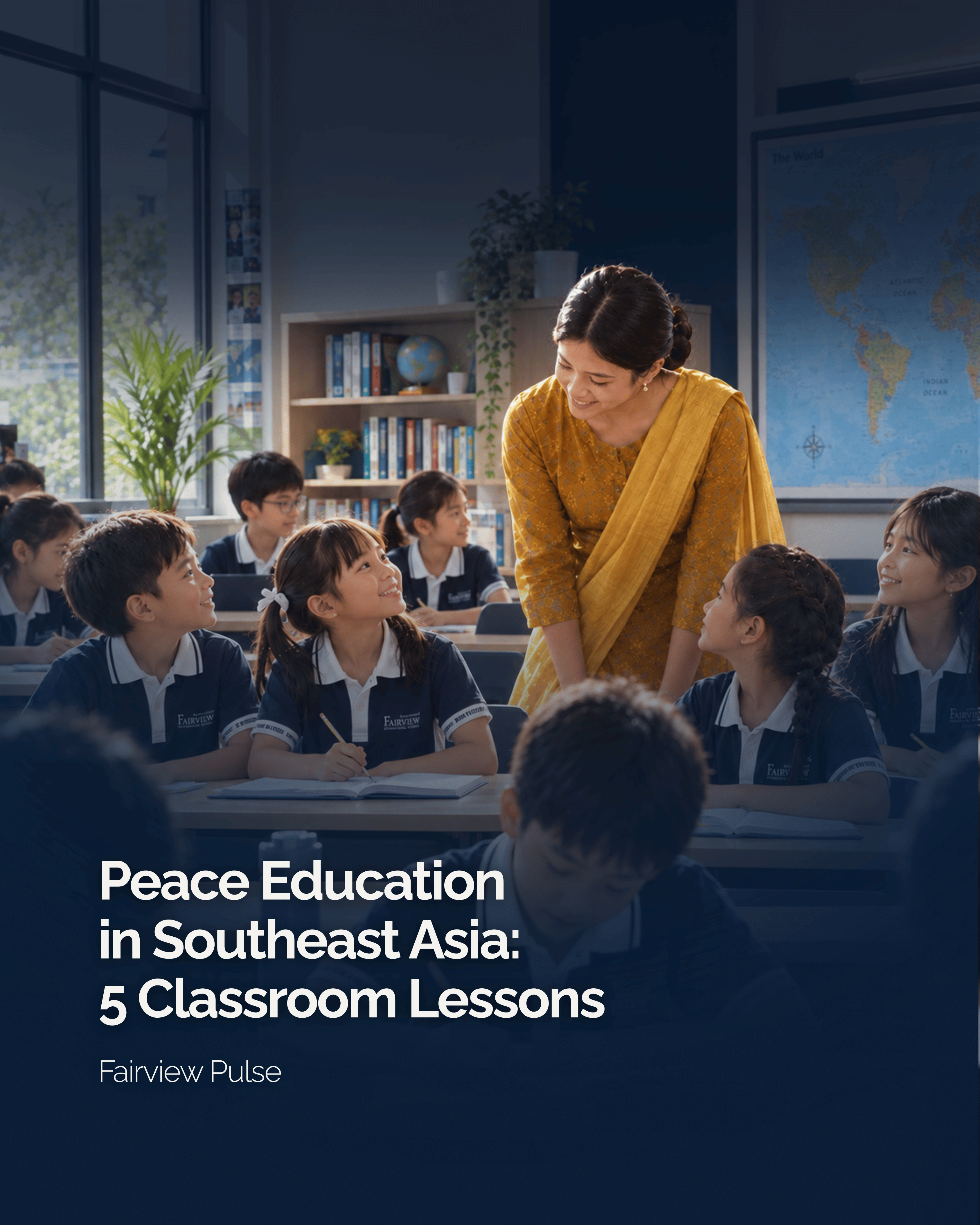
The teachers below are illustrative examples. Each shows a peace education practice that helps students live and work with people who are different from them.
1. Learning to cooperate
Ms. Nguyen teaches at an international school in Vietnam. She puts students such as Mei Ling from China and Siti Aishah from Malaysia into shared group projects. They learn to listen to each other’s views and build mutual respect.
Researchers who compare cultures, such as Geert Hofstede, often describe many Southeast Asian societies as more collectivist, with a strong focus on group harmony. In classrooms, that can mean a stronger emphasis on shared success. Countries and teachers differ, so this is a tendency, not a rule.
Competition still has value, because students learn from stretching themselves. The question is balance. When every task is ranked individually, cooperation gets less practice.
2. Valuing understanding alongside achievement
Mr. Rahman is an Indonesian teacher at an international school. He weaves lessons on tolerance and respect into his regular teaching. Students such as Arif from Indonesia and Kumar from India learn about each other’s cultures and religions, and why understanding matters.
Policy points the same way. Multicultural education has become a recognised reform aim in Indonesia. Yet research with Indonesian primary teachers points to limited curriculum flexibility as a major barrier, and a 2026 review of the region lists stereotypes, language barriers and unequal access as further obstacles. Good intentions on paper still depend on teachers who are given the room and support to act on them.
Academic results matter. Understanding others is part of a good education, not a distraction from it.
3. Working across cultures
Ms. Lee, a teacher from Singapore, asks students such as Jia Wei from China and Amara from the Philippines to work on projects with classmates from different backgrounds. They build empathy and learn to communicate across cultures.
Young people across ASEAN also practise this outside school. The eMpowering Youths Across ASEAN programme, run by the ASEAN Foundation and Maybank Foundation, has supported 482 youth volunteers and 50 community projects since 2018.
Debate sharpens reasoning. It works best alongside shared projects like Ms. Lee’s, where students must build something together.
4. Talking through conflict
Mr. Bui, a teacher from Vietnam, uses role-play to teach conflict resolution. Students such as Thuy from Vietnam and Liem from Laos practise talking through disagreements and finding a peaceful way forward.
Schools need clear rules, and good order matters. Role-play adds something rules alone cannot. It gives students practice at settling disagreements themselves, which they will need long after they leave school. You can read more in our article on restorative discipline.
5. Diversity as a strength
Southeast Asia’s diversity is one of its great strengths. Communities bring different experiences and skills, and healthy societies find ways to bring them together toward shared goals.
Ms. Surya, a teacher from Malaysia, celebrates cultural festivals in class. Students such as Noor from Malaysia and Wei from China share their own traditions with classmates. This builds real appreciation for difference.
Festivals are a starting point. The deeper work is helping students understand why a tradition matters to the person sharing it.
Peace education in Southeast Asia: what educators are saying now
The region is treating this question seriously. On 22 and 23 September 2026, more than 400 education leaders, policymakers and peace practitioners gathered in Quezon City for the ASEAN Peace Education High-Level Conference, part of the Philippines’ 2026 ASEAN chairship.
Speakers argued that peace education should build empathy, intercultural understanding and critical thinking, and teach young people to resolve differences without violence. They also stressed that it has to reach beyond the classroom, and that young people need to tell fact from falsehood in an age of AI and online misinformation. Philippine higher education officials described a new ASEAN policy document aimed at strengthening teacher education, since teachers sit at the centre of values formation.
For schools and families, the lesson is practical. Peace education is not another subject to squeeze into the timetable. It is a set of habits: listening, questioning sources and disagreeing with respect. Teachers build them in everyday lessons, and parents can reinforce them at home by asking a child to explain a view they do not share.
How Fairview approaches this
At Fairview International School, an International Baccalaureate (IB) school in Malaysia, we do not teach values in a separate class. They are part of everyday lessons across subjects, which is where we think peace education belongs.
Our students learn through the IB Learner Profile, a set of ten qualities that includes being open-minded and principled. They work in groups, and our service projects ask them to plan, act, reflect and evaluate. They also learn that two people can see the same issue differently and each have a fair point.
Conclusion
Mahbubani’s observation holds a useful lesson. In a world that can feel divided, Southeast Asia shows what dialogue can achieve, even when its record is imperfect.
If we want a world that cooperates rather than competes, and talks rather than fights, peace education has to start with teachers who help students listen, disagree with respect and work together.
Peace is more than a topic taught in class or a skill practised for a term. It grows from the values each person holds, and it shows in how they live.
To see how this works in practice, read about school admission at Fairview or send us an enquiry.