As more parents explore international schools in KL and compare options across IB schools in Malaysia, a new question is emerging:
If AI can teach, what is the role of a teacher now?
Something shifted recently.
Children realised they could ask an AI tool a difficult question and get a clear, patient answer within seconds. No waiting. No hesitation. Just an answer.
It is genuinely useful.
For families considering private schools in Kuala Lumpur or evaluating different education systems, this raises an important question:
If AI can explain, simplify, and personalise learning, where does the teacher add value?
So What Has Actually Changed?
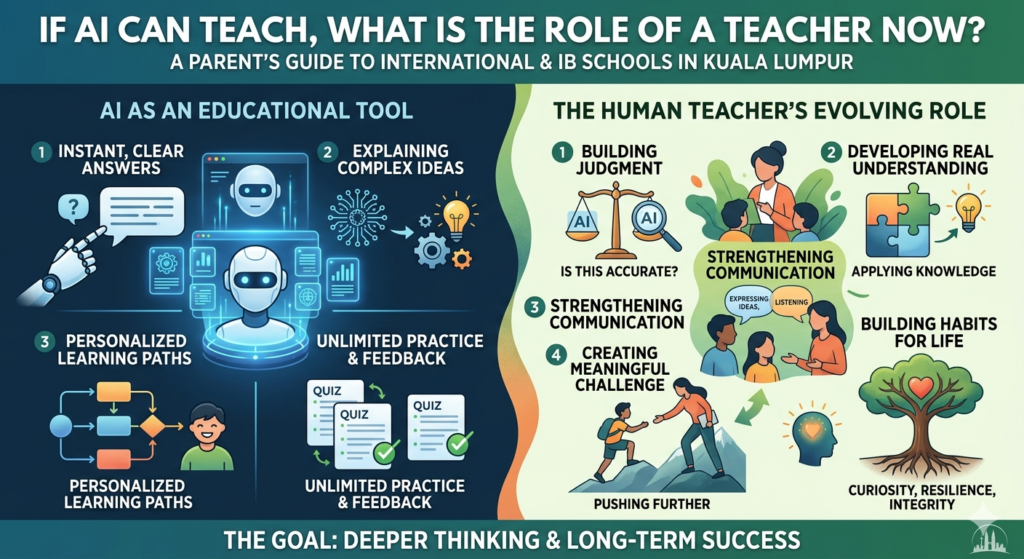
AI is already shaping how students learn.
It helps them:
- Understand complex ideas more easily
- Get instant feedback
- Practise at their own pace
This is one reason why many parents exploring IB international schools in Malaysia are also thinking about how technology fits into their child’s education.
But while AI improves access to information, it does not replace learning itself.
What AI Does Well and What It Cannot Replace
AI is effective at:
- Explaining concepts clearly
- Simplifying information
- Generating practice
- Providing immediate feedback
These are valuable tools.
However, learning is more than getting answers.
Getting the correct answer quickly is not the same as understanding it deeply.
Completing a task is not the same as thinking independently.
This is where teachers become even more important.
What Teachers Now Do That Matters More Than Ever
As AI takes on routine tasks, teachers focus on what shapes long-term learning.
1. Building Judgment
In a world full of instant answers, students must learn to ask:
- Is this accurate?
- What is missing?
- Should I question this?
Judgment develops through guided thinking, not automation.
2. Developing Real Understanding
A student who can apply knowledge, explain it clearly, and connect ideas has truly learned.
This depth of understanding is a key outcome of the IB programme in Malaysia, where students are encouraged to think beyond memorisation.
3. Strengthening Communication
AI cannot replace human interaction.
Students still need to learn how to:
- Express ideas clearly
- Listen and respond
- Collaborate effectively
These are essential skills in both school and life.
4. Creating Meaningful Challenge
Great teachers know when to push students further.
They adapt learning based on the individual, something no tool can fully replicate.
5. Building Habits for Life
Beyond academics, schools must develop:
- Curiosity
- Resilience
- Integrity
- Independent thinking
These qualities are central to IB in Malaysia, where education focuses on developing the whole child.
Why This Matters for Your Child
In an AI-driven world, the most valuable education is not the one that delivers the most content.
It is the one that develops thinking.
This is why many families are moving towards IB schools in Kuala Lumpur and across Malaysia.
A child who only learns to get answers quickly may succeed in the short term.
But a child who learns to think, question, and apply knowledge will succeed in the long term.
What to Look for in a School
When choosing between international schools in Malaysia or a private school in KL, consider:
- Is your child being asked to think, or just produce answers?
- Is technology supporting learning, or replacing it?
- Are teachers focused on developing understanding, not just performance?
These questions matter more than whether a school simply uses AI.
The Role of Schools in the Age of AI
At Fairview International School, technology supports learning, but it does not define it.
As one of the established IB schools in Malaysia, Fairview focuses on developing students through:
- The IB primary years programme
- The IB middle years programme
- The International Baccalaureate Diploma Malaysia (IBDP Malaysia)
These programmes are designed to help students think independently, communicate effectively, and apply knowledge in real-world contexts.
Because education is not about how quickly a child can find an answer.
It is about how well they understand, question, and use it.