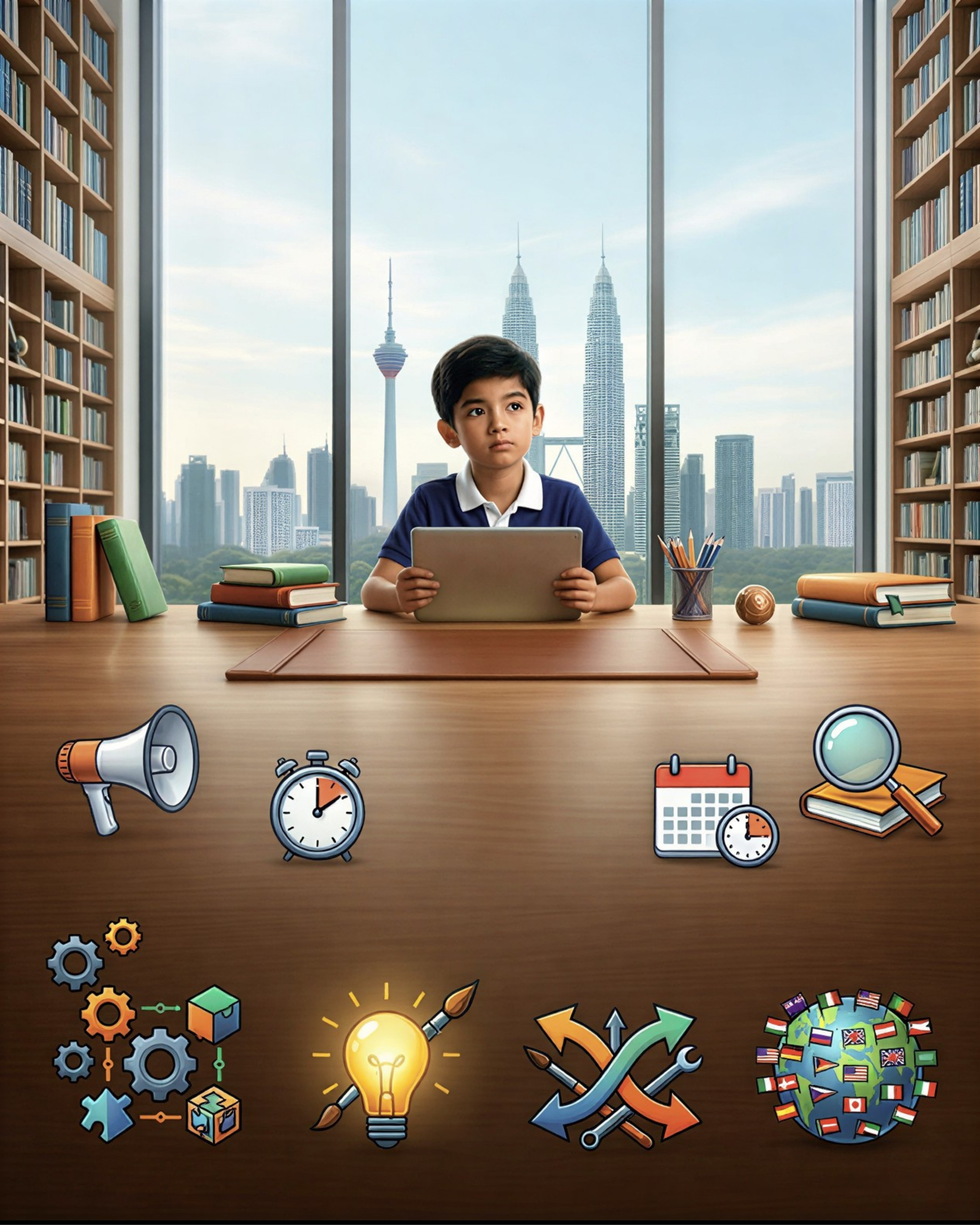
When parents explore international schools in KL or compare options across IB schools in Malaysia, one question often comes up:
Which curriculum suits my child best?
Principal Zhao has had this conversation many times.
A parent sits across from her and says, “My daughter is a visual learner. She needs a curriculum that matches how she learns.”
Zhao understands the concern. She once believed the same thing, before she began looking closely at the research.
Here is what that research shows.
A major review published in Psychological Science in the Public Interest examined studies on learning styles and found no strong evidence to support using them in classrooms. No controlled study showed that matching teaching to a child’s preferred “style” improves outcomes.
Yet the belief remains widespread, especially among families choosing between private schools in Kuala Lumpur and other education pathways.
Why This Belief Feels So Real
It is easy to see why.
Some children seem more comfortable in exams. Others appear to do better in open-ended tasks. Over time, it feels natural to label them. Exam type. Project type.
These patterns are familiar. They give parents a simple way to explain differences when comparing international schools in Malaysia Kuala Lumpur.
However, what feels true is not always what is happening underneath.
Learning Is Not the Same as Performance
Research shows a critical distinction.
Doing well in a task does not always mean deep learning has taken place.
A review in Perspectives on Psychological Science found that short-term performance can improve even when long-term understanding does not. In some cases, methods that make students look confident can actually reduce how well they retain and apply knowledge later.
This means a student who performs well in exams may not always be developing the ability to apply that knowledge in new situations.
What the Evidence Actually Tells Us
When researchers test whether matching teaching to a student’s preferred style improves outcomes, the answer is consistent.
It does not.
A 2025 meta-analysis found the effect to be almost zero.
So what explains the differences we see?
In most cases, it comes down to exposure.
A child who is comfortable with exams has been trained for exams. A child who struggles with open-ended thinking may simply not have had enough opportunities to develop that skill yet.
When we treat these differences as fixed, we lower expectations. We stop asking how the system can help the child grow.
The Risk of Getting This Wrong
When we assume some children are not suited to certain types of learning, we unintentionally limit them.
We begin to choose pathways based on comfort, not growth.
Over time, this shapes outcomes.
Because the system does not adapt to the child.
The child adapts to the system.
What the World Now Demands
The world outside school is changing quickly.
According to the World Economic Forum Future of Jobs Report 2025, analytical thinking is the most in-demand skill globally. Creativity, curiosity, and adaptability are also increasingly valued.
These are core outcomes of the IB programme Malaysia and are central to how modern education prepares students for life beyond school.
These skills are developed through:
- Inquiry and exploration
- Independent thinking
- Continuous feedback
- Applying knowledge in unfamiliar situations
This is why many families today are actively exploring IB international schools in Malaysia.
When the System Changes, Outcomes Change
Andi spent years teaching in an exam-focused system.
Her students performed well in structured assessments. But when questions changed, many struggled. The gap between what they knew and what they could do became clear.
Later, she began teaching in a system built around inquiry, continuous assessment, and independent research.
Her understanding of learning changed.
A 2021 study by Jisc followed over 61,000 students in an inquiry-based pathway, such as the International Baccalaureate Diploma Malaysia, and compared them with 1.2 million students in a traditional exam-focused system.
After accounting for background and prior achievement, students in the inquiry-based system were significantly more likely to enter top universities and achieve stronger outcomes.
The difference was not the type of child.
It was the design of the system.
What a Strong Learning System Does
A well-designed system does not try to match a child to a label.
It develops the child.
In strong IB environments, including the IB primary years programme, IB middle years programme, and IBDP, students are encouraged to:
- Read widely and form their own perspectives
- Design investigations and interpret results
- Produce sustained independent work
- Apply knowledge in new contexts
This builds the ability to think, adapt, and transfer learning across situations.
Rethinking What Really Matters
Even high-performing systems are beginning to question their own measures.
Singapore’s Minister for Education has acknowledged that doing well in exams may not matter as much later in life.
This reflects a growing understanding that what we measure is not always what matters most.
A Better Question to Ask
So the question is not:
Which curriculum suits my child?
A better question is:
Does this school teach in a way that supports how all children learn?
Decades of research point in a clear direction.
- Inquiry builds thinking
- Feedback builds awareness
- Breadth builds adaptability
These are not benefits for a certain type of child.
They matter for every child.
What This Means for Parents in Kuala Lumpur
For families exploring international schools in KL or considering a private school in KL, the goal should not be to find a system that matches a child’s current strengths.
It should be to choose a system that helps the child grow.
At Fairview International School, learning is designed around this belief.
As one of the established IB schools in Malaysia, Fairview focuses on developing students who can think independently, adapt confidently, and apply what they learn in real-world situations.
Because education is not about finding the right fit.
It is about preparing children for life.