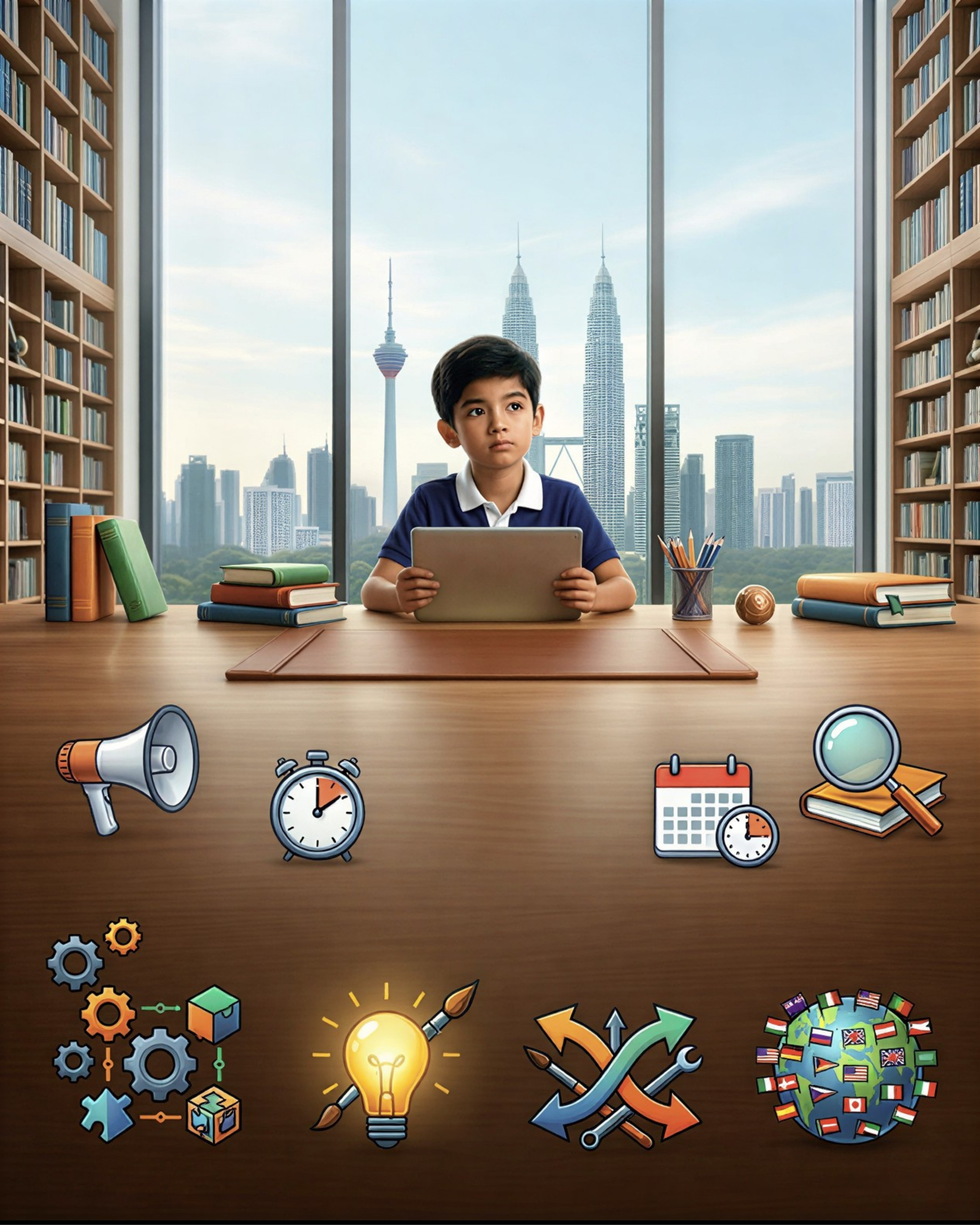
When parents explore international schools in KL or compare options across Malaysia IB schools, one common question comes up:
Which curriculum suits my child best?
Some children seem to do well in exams. Others appear more comfortable with projects and open-ended tasks. It feels natural to assume that different children need different systems.
But research tells a different story.
Why This Belief Feels True
Parents often notice their child performing differently across environments. Schools also position themselves around these differences, especially when comparing IB international schools in Malaysia with more traditional, exam-focused systems.
Over time, it becomes easy to believe that success depends on finding the “right fit”.
However, what feels true is not always what is happening underneath.
How Children Actually Learn
There is an important distinction in education:
How children learn
and
how teaching is delivered
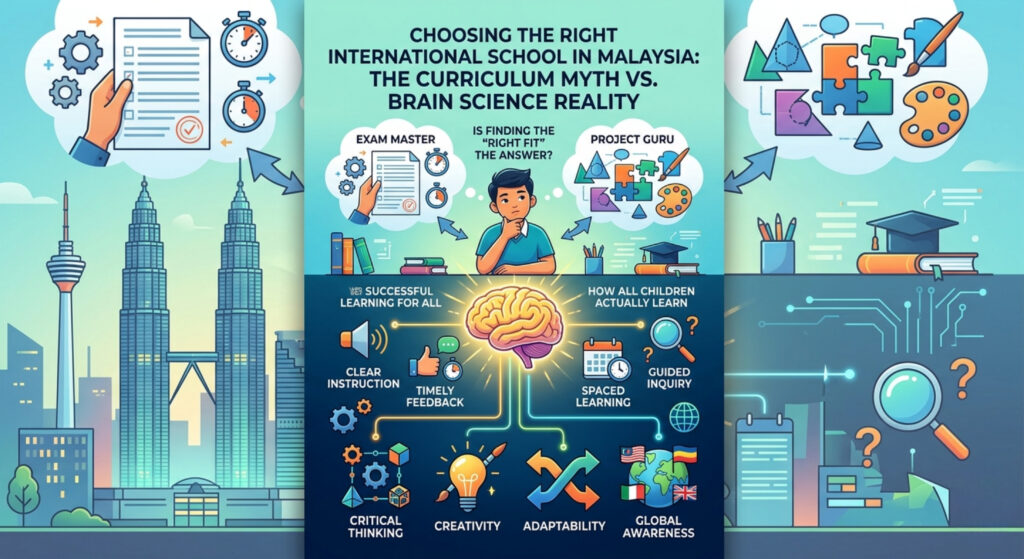
These are not the same.
Decades of research show that certain methods consistently improve learning outcomes for all students. These include:
- Clear instruction
- Timely feedback
- Spaced learning
- Guided inquiry
These are not preferences. They are how the brain learns.
Good teachers adapt how they deliver these methods based on the learner. But this does not mean children need completely different curricula.
It means teaching needs to be done well.
What the Evidence Shows Across Education Systems
Across different countries and systems, the same conclusion appears.
Strong teaching practices benefit all learners.
This is why many top rated international schools and IB schools in Malaysia focus on inquiry, reflection, and application, rather than memorisation alone.
Research comparing inquiry-based pathways such as the International Baccalaureate Diploma in Malaysia with traditional exam-focused routes shows that students in inquiry-based systems are more likely to succeed in university and beyond.
The difference is not the type of child.
It is the design of the system.
Why “Learning Styles” Can Be Misleading
The idea that children are “exam learners” or “project learners” often comes from familiarity.
A child who performs well in exams has usually been trained for exams. A child who struggles with open-ended thinking may not have had enough exposure to it yet.
When we label children this way, we unintentionally lower expectations.
Instead of asking how the system can help them grow, we accept their current comfort level as fixed.
What Today’s World Actually Requires
The reality is simple.
The world students are entering is changing fast.
Skills like analytical thinking, creativity, and adaptability are now essential. These are consistently highlighted in global workforce research and are central to modern education frameworks such as the IB programme Malaysia.
These skills are not built through memorisation alone.
They are developed through:
- Inquiry and exploration
- Independent thinking
- Continuous feedback
- Applying knowledge in new situations
This is why many parents today are actively exploring international schools in Kuala Lumpur, Malaysia that offer a more balanced and future-focused approach.
What a Strong Learning System Looks Like
A well-designed system does not try to match a child to a label.
It develops the child.
In strong IB environments, including the IB primary years programme, IB middle years programme, and IBDP Malaysia, students are encouraged to:
- Ask questions and explore ideas
- Build understanding over time
- Apply knowledge in real-world contexts
- Reflect on their learning
This approach helps students learn how to think, not just what to remember.
A Better Question for Parents to Ask
So instead of asking:
Which curriculum suits my child?
A more useful question is:
Does this school teach in a way that supports how all children learn?
Because research is clear.
- Inquiry builds thinking
- Feedback builds awareness
- Breadth builds adaptability
These are not benefits for a certain type of student.
They matter for every child.
What This Means for Parents in Kuala Lumpur
For families exploring private schools in KL or comparing international schools in Kuala Lumpur, the focus should not be on matching a child to a system.
It should be on choosing a system that helps the child grow beyond their current abilities.
At Fairview International School, this belief shapes how learning is designed.
As one of the established IB international schools in Malaysia, Fairview focuses on developing students who can think independently, adapt confidently, and apply what they learn in real-world situations.
Because education is not about fitting into a system.
It is about preparing for life.